HomePowerIQ is reader-supported. When you buy through links on our site, we may earn a commission at no extra cost to you. As an Amazon Associate we earn from qualifying purchases. Our picks are based on specs, prices and published data, never on payment. How we make money.
On this page
Short answer: a solar generator is a portable power station plus solar panels. For home backup, look for at least 2,000 Wh of LiFePO4 battery, 800 W or more of panels and a unit that can take a transfer switch. Our picks: EcoFlow DELTA Pro 3 with 400 W panels (best overall), Anker SOLIX F3800 Plus (best for 240V whole-home backup), Jackery Explorer 5000 Plus (most capacity in one box), BLUETTI Elite 200 V2 (best 2 kWh value) and EcoFlow DELTA 3 Plus (best budget starter).
How we picked: we compared manufacturer specs for battery capacity, AC output, 120/240V support, maximum solar input and expandability, then matched each kit to a home backup need. We have not hands-on tested these units. Solar output estimates use typical sun hours, not lab numbers.
Quick comparison
| Power station | Capacity | AC output | Max solar input | 240V? | Best for |
|---|---|---|---|---|---|
| EcoFlow DELTA Pro 3 | 4,096 Wh | 4,000 W (8,000 W surge) | 2,600 W | Yes | Best overall solar backup |
| Anker SOLIX F3800 Plus | 3,840 Wh | 6,000 W | 3,200 W | Yes | Whole-home and 240V loads |
| Jackery Explorer 5000 Plus | 5,040 Wh | 7,200 W | 4,000 W | Yes | Most capacity in one unit |
| BLUETTI Elite 200 V2 | 2,073.6 Wh | 2,600 W (3,900 W surge) | See maker | No | Best 2 kWh value |
| EcoFlow DELTA 3 Plus | 1,024 Wh | 1,800 W (3,600 W surge) | See maker | No | Budget starter, expandable to 5 kWh |
Specs from each maker’s product page, November 2026. Bundles change often, so check which panels are included and the current price before you buy.
What is a solar generator?
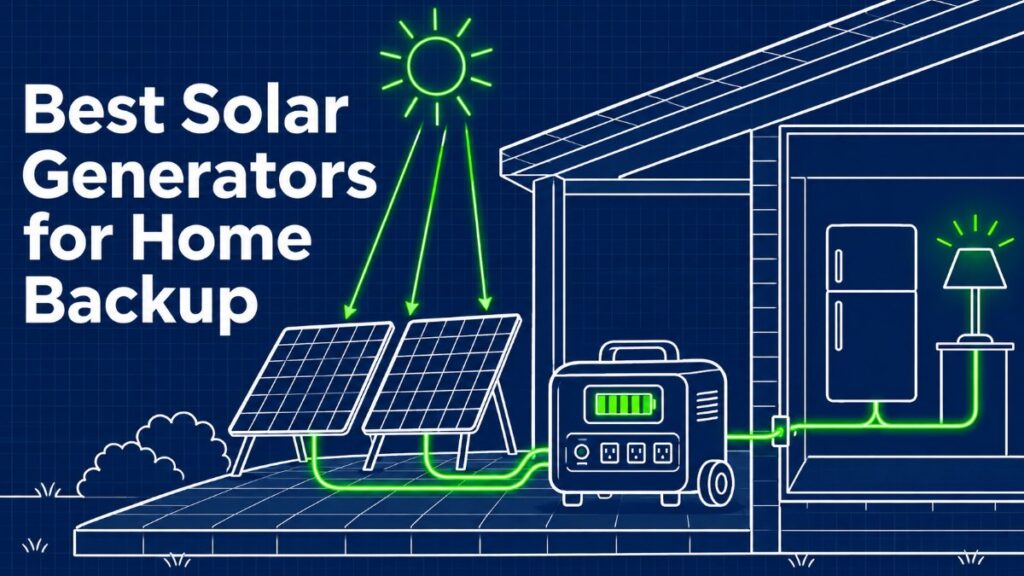
A “solar generator” is not a generator in the gas sense. It is a battery power station paired with portable or rigid solar panels. The panels recharge the battery during the day, and the battery runs your fridge, lights, Wi-Fi and medical devices at night. There is no fuel, no exhaust and no noise, so it is safe to run indoors.
The trade-off is speed. A gas generator makes as much power as you can feed it fuel. A solar generator only gives back what the sun puts in, so a cloudy week can drain it. That is why capacity and panel wattage matter more than any other spec.
The best solar generators for home backup
EcoFlow DELTA Pro 3
- Capacity: 4,096 Wh LFP
- Output: 4,000 W (8,000 W surge)
- Voltage: 120V / 240V
- Solar input: up to 2,600 W (two inputs)
- Expandable: up to 12 kWh per unit
The DELTA Pro 3 is the most complete solar backup kit for a typical house. Its two solar inputs take up to 2,600 W combined, so a set of four 400 W panels can put back roughly 4 to 5 kWh on a sunny day, which is about a full recharge. It handles a fridge, furnace fan and well pump, and you can add extra batteries for multi-day outages. Read our full EcoFlow DELTA Pro 3 review for runtime math.
What we like
- Runs 240V loads like a well pump
- Two solar inputs for faster recharging
- Works with EcoFlow Smart Home Panel 2 and transfer switches
Watch out for
- About 113.5 lb on wheels
- Premium price, panels sold separately or in bundles
Anker SOLIX F3800 Plus
- Capacity: 3,840 Wh LFP
- Output: 6,000 W
- Voltage: 120V / 240V
- Solar input: up to 3,200 W
- Expandable: up to 26.9 kWh per unit
If you want to back up a whole panel of circuits, the F3800 Plus has the most output here and takes up to 3,200 W of solar. It can also recharge from a 240V gas generator, which makes it a good hybrid setup: solar on sunny days, a small generator during a long storm.
What we like
- Highest output in this group
- Built-in L14-30 and TT-30 ports
- Can recharge from a 240V gas generator
Watch out for
- Very heavy
- Best value only if you need 240V power
Jackery Explorer 5000 Plus
- Capacity: 5,040 Wh LFP
- Output: 7,200 W
- Voltage: 120V / 240V
- Solar input: up to 4,000 W
- Expandable: to 60 kWh with two units
Jackery’s Solar Generator 5000 Plus bundles are built for homes that want several days of backup from one box. With 4,000 W of solar input it recharges faster than anything else in this list when you have the roof or yard space for the panels.
What we like
- Biggest single battery here
- Highest solar input
- Pairs with Jackery's smart transfer switch
Watch out for
- About 134.5 lb
- Overkill for essentials-only backup
BLUETTI Elite 200 V2
- Capacity: 2,073.6 Wh LFP
- Output: 2,600 W (3,900 W surge)
- Voltage: 120V
- Expandable: no
For an apartment or a house that only needs the fridge, Wi-Fi, lights and a CPAP covered, a 2 kWh unit with one or two 200 W panels is the sweet spot. The Elite 200 V2 gives you the most capacity per dollar at this size.
What we like
- Strong price per watt-hour
- Enough to run a fridge and essentials overnight
- Lighter than the big 240V units
Watch out for
- No 240V
- Not expandable
EcoFlow DELTA 3 Plus
- Capacity: 1,024 Wh LFP
- Output: 1,800 W (3,600 W surge)
- Voltage: 120V
- Expandable: up to 5 kWh
Start with the DELTA 3 Plus and a 220 W panel if your budget is tight. It covers phones, lights, a router and a few hours of fridge, and you can add extra batteries later instead of replacing the whole unit.
What we like
- Low entry price
- Add batteries later instead of buying a bigger unit
- Fast switchover for computers and routers
Watch out for
- Small base capacity
- No 240V
How much solar do you need?
A good rule of thumb: each 400 W of panels gives back about 1.2 to 1.6 kWh per day in most of the US, based on 4 to 5 peak sun hours and normal losses. Winter and cloudy days can cut that in half.
| Panels | Daily recharge (sunny) | What it covers |
|---|---|---|
| 200 W | About 0.6 to 0.8 kWh | Phones, lights, router, CPAP |
| 400 W | About 1.2 to 1.6 kWh | A modern fridge plus small loads |
| 800 W | About 2.4 to 3.2 kWh | Fridge, freezer, Wi-Fi, lights and fans |
| 1,600 W | About 5 to 6.5 kWh | Most essentials every day, plus a well pump |
To size the battery side, add up what you want to run with our backup power calculator. If the fridge is your main worry, see how many watts a refrigerator uses.
How to connect a solar generator to your house
You have three options. The simplest is running extension cords to the fridge and a few lamps. The cleaner option is a manual transfer switch or an interlock kit that lets the power station feed chosen circuits through your panel. The most automatic option is a maker’s smart panel, like EcoFlow’s Smart Home Panel 2 or Anker’s Home Power Panel, which switches over by itself when the grid drops. Hardwired setups need a licensed electrician.
Solar generator or gas generator?
A solar generator is quieter, safe indoors and has no fuel to store. A gas or propane generator is cheaper per watt and keeps going as long as you have fuel. Many homeowners end up with both. We compare them side by side in home battery backup vs generator, and our best generator for home backup guide covers the fuel side.
Frequently asked questions
Can a solar generator power a whole house?
Large units like the Anker SOLIX F3800 Plus, Jackery Explorer 5000 Plus and EcoFlow DELTA Pro 3 can power many circuits, including some 240V appliances, through a transfer switch. Running central AC, an electric dryer and an electric range all day is beyond any single portable unit.
How long does a solar generator last during an outage?
It depends on the battery and the sun. A 4 kWh unit running about 3 kWh a day of essentials lasts roughly a day on battery alone, and much longer if panels refill it each day.
Do solar generators work in winter?
Yes, but panels make less power on short, cloudy days. Plan on about half the summer output and keep the battery topped off from the wall before a storm.
Is a solar generator worth it for home backup?
It is worth it if you want quiet, fuel-free backup for essentials, live where outages are short or frequent, or cannot run a gas generator safely. For multi-day outages with heavy loads, a standby generator is usually cheaper.
Can I use a solar generator indoors?
Yes. Battery power stations make no exhaust, so they are safe indoors. Keep the solar panels outside.