HomePowerIQ is reader-supported. When you buy through links on our site, we may earn a commission at no extra cost to you. As an Amazon Associate we earn from qualifying purchases. Our picks are based on specs, prices and published data, never on payment. How we make money.
On this page

Short answer: the best whole-house battery backup for most homes is the Tesla Powerwall 3: 13.5 kWh and 11.5 kW of power for about $13,000 to $16,500 installed. Pick the FranklinWH aPower 2 for more storage per unit, the Enphase IQ Battery 5P if you have Enphase solar, or a DIY-friendly system like the EcoFlow DELTA Pro Ultra or Anker SOLIX F3800 Plus to cut the cost roughly in half.
How we picked: we compared manufacturer specs for usable capacity, continuous power, expandability and warranty, plus published installed-cost data. We have not hands-on tested these systems. Prices are as of November 2026, before local rebates.
Quick comparison
| System | Capacity per unit | Continuous power | Typical cost | Install |
|---|---|---|---|---|
| Tesla Powerwall 3 | 13.5 kWh | 11.5 kW | $13,000 to $16,500 installed | Certified installer |
| FranklinWH aPower 2 | 15 kWh | 10 kW | About $17,500 installed | Certified installer |
| Enphase IQ Battery 5P | 5 kWh | 3.84 kW | About $6,000 to $8,500 each installed | Certified installer |
| EcoFlow DELTA Pro Ultra | 6.1 kWh per battery | 7.2 kW | About $4,100+ (inverter + 1 battery) | Plug-in, electrician for home panel |
| Anker SOLIX F3800 Plus | 3.84 kWh | 6 kW | About $3,000 to $4,000 | Plug-in, electrician for transfer switch |
Costs from EnergySage and installer and retailer listings, November 2026. Installed prices vary widely by region.
What “whole-house” battery backup really means
A whole-house system switches every circuit in your home to battery when the grid drops. That does not mean it can run everything at once for days. A 13.5 kWh battery runs a typical home’s essentials for about a day, and less with central AC or electric heat running. Most homeowners either add solar to recharge each day, buy two or more batteries, or choose partial backup of key circuits to stretch the battery.
Two numbers matter most: capacity (kWh) decides how long it lasts, and continuous power (kW) decides what it can run at the same time. Add up your loads with our backup power calculator before you shop.
The best whole-house battery backup systems
1. Tesla Powerwall 3: best overall
The Powerwall 3 gives you 13.5 kWh and 11.5 kW of continuous power, enough to start and run big loads like a heat pump or central AC. It has a solar inverter built in, so a new solar install does not need a separate inverter. It carries a 10-year warranty. The catch is price and availability: you buy through Tesla-certified installers, and expansion comes in 13.5 kWh steps. See our full Tesla Powerwall cost breakdown.
2. FranklinWH aPower 2: most storage per unit
The FranklinWH aPower 2 stores 15 kWh with 10 kW of continuous power, and its aGate controller can manage solar, grid, a backup generator and EV charging in one system. It works with almost any existing solar inverter, which makes it a strong pick for adding a battery to solar you already own. Expect about $17,500 installed for one unit.
3. Enphase IQ Battery 5P: best for Enphase solar homes
Each Enphase IQ Battery 5P holds 5 kWh and puts out 3.84 kW, with a 15-year warranty, one of the longest available. Because units are small, you can size the system in 5 kWh steps. Whole-home backup usually takes three or more units plus the IQ System Controller, so the total often ends up higher than a single Powerwall. It is the natural pick if your panels already use Enphase microinverters.
4. EcoFlow DELTA Pro Ultra: best value whole-home system
EcoFlow DELTA Pro Ultra
- Capacity: 6,144 Wh per battery, expandable to 90 kWh
- Output: 7,200 W continuous
- Voltage: 120V / 240V
- Solar input: up to 5,600 W
- Switchover: under 20 ms with Smart Home Panel 2
The DELTA Pro Ultra is a stackable inverter and battery system that sits in the garage. Paired with EcoFlow’s Smart Home Panel 2, it switches your home over automatically, much like a Powerwall, at a lower cost per kWh. You can start with one 6 kWh battery and add more later.
What we like
- Far cheaper per kWh than installer-only batteries
- Modular, add batteries over time
- Can move with you if you sell the house
Watch out for
- Heavy modules, best left in the garage
- Smart Home Panel 2 still needs an electrician
5. Anker SOLIX F3800 Plus: best portable whole-home option
Anker SOLIX F3800 Plus
- Capacity: 3,840 Wh LFP
- Output: 6,000 W
- Voltage: 120V / 240V
- Expandable: up to 26.9 kWh per unit
- Solar input: up to 3,200 W
If you want whole-home style backup without a five-figure quote, the F3800 Plus is the budget route. Connect it through a transfer switch or Anker’s Home Power Panel, add expansion batteries as needed, and recharge from solar or a gas generator in a long outage.
What we like
- Lowest entry cost here
- Recharges from a 240V gas generator
- Works with a transfer switch or Anker Home Power Panel
Watch out for
- About 73 lb before expansion batteries
- Smaller base battery than wall systems
How many batteries do you need?
| Your goal | Storage to plan for | Example setup |
|---|---|---|
| Essentials for one night | 5 to 10 kWh | 1 Enphase 5P or 1 DELTA Pro Ultra battery |
| Essentials for about a day | 10 to 15 kWh | 1 Powerwall 3 or 1 aPower 2 |
| Whole home with central AC for a day | 20 to 30 kWh | 2 Powerwalls, or a Powerwall plus expansion |
| Multi-day outages | Battery plus solar or a generator | Any of the above with solar panels |
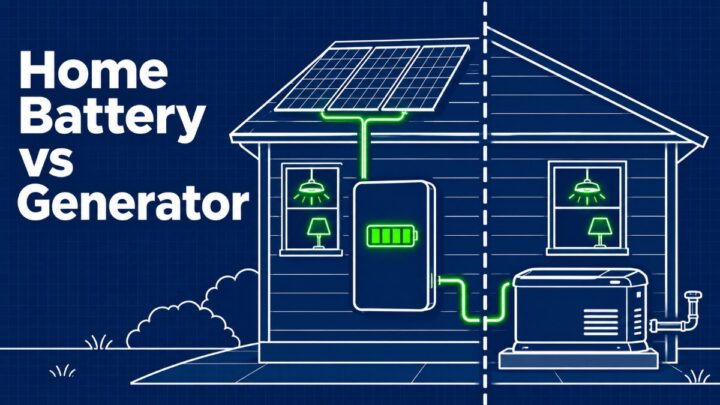
If you expect long outages and run heavy loads, a standby generator is often cheaper. Many homes pair a battery for short outages with a generator for long ones. We compare both in home battery backup vs generator.
Do you still get a tax credit?
The federal 30% Residential Clean Energy Credit (Section 25D) ended for homeowner purchases after December 31, 2025, so batteries installed in 2026 do not qualify. Some states and utilities still pay battery rebates or yearly incentives, especially for joining grid programs. Ask installers what applies in your area.
Frequently asked questions
What is the best battery backup for a whole house?
For most homes, the Tesla Powerwall 3, because it has the most power of any single residential battery at a competitive installed price. The FranklinWH aPower 2 holds more energy per unit, and the EcoFlow DELTA Pro Ultra is the best value.
How much does whole-house battery backup cost?
About $13,000 to $17,500 installed for one Powerwall 3 or FranklinWH aPower 2 in 2026. Plug-in systems like the EcoFlow DELTA Pro Ultra or Anker SOLIX F3800 Plus start around $3,000 to $4,500, plus electrician costs for a panel or transfer switch.
How long will a home battery run my house?
A 13.5 kWh battery runs essentials for about a day. Running central AC, an electric water heater or electric heat cuts that to hours. Solar panels can recharge it daily.
Can a home battery run central air conditioning?
A Powerwall 3 or FranklinWH aPower 2 can usually start and run a typical central AC unit. Smaller batteries may need a soft starter or may not handle it.
Is a whole-house battery better than a generator?
A battery is silent, automatic and needs no fuel, and with solar it saves money every day. A generator costs less up front and runs as long as it has fuel. The right choice depends on how long your outages last.