HomePowerIQ is reader-supported. When you buy through links on our site, we may earn a commission at no extra cost to you. As an Amazon Associate we earn from qualifying purchases. Our picks are based on specs, prices and published data, never on payment. How we make money.
On this page
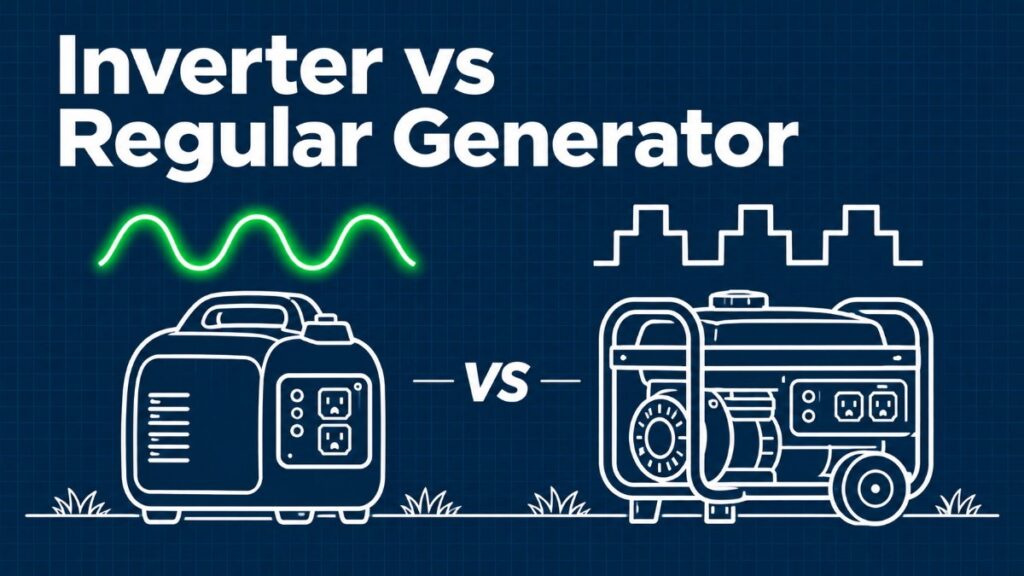
Short answer: an inverter generator makes clean, stable power (about 3% total harmonic distortion or less), throttles its engine to match the load, and is much quieter and more fuel-efficient. A regular (conventional) generator runs at a fixed 3,600 RPM, is louder and thirstier, but gives you far more watts per dollar. For home backup, pick an inverter if you need under about 4,000 watts or want quiet, efficient power; pick a conventional generator if you need 7,500+ watts on a budget, or consider a large inverter if you want both.
Inverter vs regular generator at a glance
| Inverter generator | Regular (conventional) generator | |
|---|---|---|
| Power quality | Clean: about 3% THD or less | Often 10–25% THD or more |
| Engine speed | Varies with the load | Fixed, about 3,600 RPM |
| Noise | Quieter, often 50–60 dB at light load | Louder, often 65–75 dB |
| Fuel use | Lower, especially at light loads | Higher, burns the same at any load |
| Typical sizes | 1,000–9,000 W | 3,500–15,000+ W |
| Price per watt | Higher | Lower |
| Weight | Lighter for the same output | Heavier, open frame |
| Best for | Electronics, quiet neighborhoods, long runtimes on light loads | Big loads on a budget, well pumps, whole-panel backup |
Noise and THD figures vary by model; always check the spec sheet.
How each type works
A conventional generator spins its alternator at a constant speed to make 60 Hz AC power directly. That simple design is cheap to build and scales up to large outputs, but the engine runs at full speed even when you are only powering a fridge.
An inverter generator makes high-frequency AC, converts it to DC, then electronically “inverts” it back to a clean 60 Hz sine wave. Because the electronics set the frequency, the engine can slow down when demand is low, which saves fuel and cuts noise.
Which is better for home backup?
Choose an inverter generator if…
- You mainly need the fridge, freezer, lights, Wi-Fi, phones and a TV
- You live close to neighbors or have HOA noise rules
- Outages are long and you want to stretch your fuel
- You will also use it for camping or RVs
Choose a conventional generator if…
- You need 7,500 watts or more for a well pump, central AC or electric water heater
- Budget matters more than noise
- You plan to connect it through a transfer switch or interlock kit and power much of the panel
Not sure how many watts you need? Our generator size calculator adds up your appliances, including the starting surge from motors like fridges and pumps.
Is “dirty power” from a regular generator really a problem?
Most modern electronics have power supplies that tolerate some distortion, and many newer conventional generators advertise low-THD output. Still, higher distortion can make motors run hotter and can upset sensitive devices like some furnace control boards, variable-speed equipment and medical devices. If you will run those, an inverter generator, or a conventional model rated under 5% THD, is the safer choice.
What about dual fuel and large inverters?
Many models in both categories now run on gasoline or propane (dual fuel), and some add natural gas (tri-fuel). Propane stores for years without going stale, a big plus for emergency use. Large open-frame inverter generators in the 7,000–9,000 watt range bridge the gap: near-conventional output with inverter power quality, at a higher price.
View on AmazonLarge dual-fuel inverter generators
View on AmazonConventional dual-fuel generators
Safety reminder: both types make deadly carbon monoxide. Run any generator outdoors, at least 20 feet from the house. See how to hook up a generator safely.
Related: Best generator for home backup
Frequently asked questions
Is an inverter generator worth the extra cost?
For light-to-medium loads, usually yes: it is quieter, burns less fuel over a long outage and is gentler on electronics. For heavy loads on a budget, a conventional generator gives more watts per dollar.
Can an inverter generator run a refrigerator?
Yes, as long as it can handle the fridge’s starting surge. A 2,000–3,000 watt inverter generator typically runs a standard fridge plus a few small loads. See how many watts a refrigerator uses.
Are inverter generators safe for computers and TVs?
Yes. Their low-distortion output is comparable to utility power.
Can I connect an inverter generator to my house?
Yes, if it has a 30A (L5-30 or TT-30) or 50A outlet, through a transfer switch or interlock kit installed by an electrician. Smaller inverters with only 20A outlets are best used with extension cords.
Do inverter generators last longer?
Running at lower RPM most of the time can reduce engine wear, but lifespan depends more on build quality and maintenance than on the generator type.
Sources: Champion Power Equipment: what is an inverter generator; Renogy: inverter generator vs generator; Electrical Trader inverter generator buying guide. Checked November 2026.