HomePowerIQ is reader-supported. When you buy through links on our site, we may earn a commission at no extra cost to you. As an Amazon Associate we earn from qualifying purchases. Our picks are based on specs, prices and published data, never on payment. How we make money.
On this page
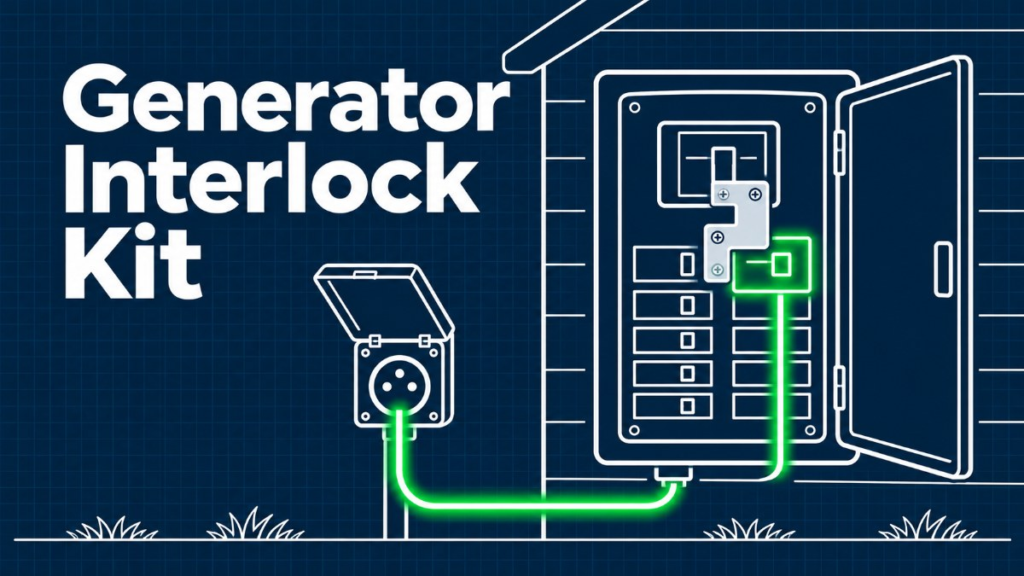
Short answer: a generator interlock kit is a small sliding plate mounted on your breaker panel cover. It makes it physically impossible to turn on your main breaker and a generator breaker at the same time, so a portable generator can safely power circuits in your existing panel. The kit itself usually costs about $50–$150. With the backfeed breaker, outdoor inlet and an electrician, plan on about $400–$850 installed. Kits are made for specific panel brands and models, so you have to buy the one that fits yours.
An interlock is the most popular low-cost alternative to a transfer switch. It lets you choose any circuit in the house during an outage instead of a fixed list, but you have to manage the load yourself. Here is how it works, what you need, what it costs and how to find the right kit for your panel.
How a generator interlock works
In a normal panel, the main breaker at the top feeds every circuit from the utility. An interlock setup adds a generator (backfeed) breaker, usually in the slot right next to the main, fed by a cord from an outdoor power inlet. The interlock plate slides so that only one of those two breakers can ever be in the ON position: if the main is on, the generator breaker is blocked off, and vice versa.
That simple mechanical lock is what prevents backfeeding, which can send generator power onto the utility lines and endanger line workers.
What you need besides the kit
| Part | What it does |
|---|---|
| Interlock kit (made for your panel) | The sliding plate and hardware that block the main and generator breakers from being on together |
| Generator breaker (2-pole, 30 A or 50 A) | Brings generator power into the panel; size it to the generator outlet and inlet |
| Breaker retaining kit | Holds the backfed breaker in place, as electrical code requires |
| Outdoor power inlet box | A weatherproof plug-in point on the outside wall |
| Generator cord (30 A or 50 A) | Connects the generator outlet to the inlet box |
| Warning labels | Code-required labels at the panel and meter |
What does an interlock kit cost?
| Item | Typical cost |
|---|---|
| Interlock kit only | $50–$150 |
| Inlet box, breaker and cord | Varies by amperage; 50 A parts cost more than 30 A |
| Installed by an electrician (kit, breaker, inlet, labor) | $400–$850 |
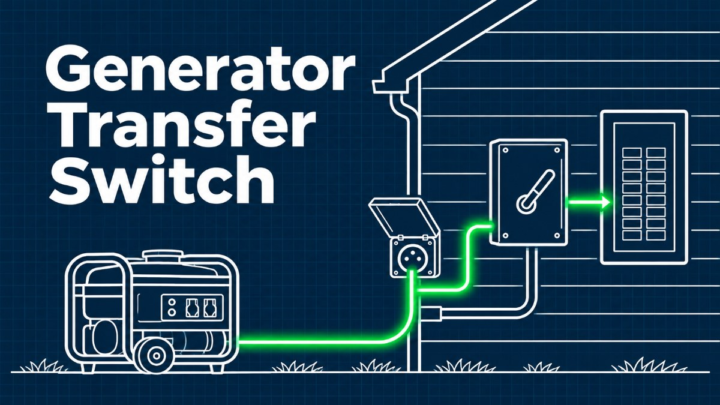
| Manual transfer switch, installed (for comparison) | $400–$1,300 |
An interlock is usually the cheapest code-compliant way to connect a portable generator. Mounting the plate takes an electrician little time; most of the labor goes into installing the inlet box and running wire to the panel.
Don’t have a generator yet? Size it first with our generator size calculator. A generator with a 30 A outlet pairs with a 30 A breaker and inlet; a 50 A outlet needs 50 A parts.
How to find the right kit for your panel
Interlock kits are not universal. Each one is designed for specific panel brands, models and amp ratings, because the plate has to line up with the exact position of the main breaker and the slot next to it.
- Open your panel door and find the label inside it. Note the brand, the model or catalog number and the amp rating (often 100 A, 150 A or 200 A).
- Check whether the main breaker sits at the top of the panel or in a separate meter-main box outside.
- Look up a kit listed for that exact panel. Common families include Square D QO and Homeline, Eaton (Cutler-Hammer) BR and CH, GE and Siemens.
- Make sure there is a free slot right next to the main breaker for the generator breaker. If not, your electrician may need to move circuits.
- Have the electrician confirm your local inspector accepts interlocks. Most do, but a few areas require a transfer switch.
Interlock kits by panel brand
These links open Amazon searches for kits by panel family. Always match the listing to the model number on your panel label before buying.
| Panel brand | Common panel lines | Find a kit |
|---|---|---|
| Square D | QO, Homeline | Square D interlock kits |
| Eaton / Cutler-Hammer | BR, CH | Eaton interlock kits |
| Siemens / Murray | QP, Murray | Siemens interlock kits |
| GE | PowerMark, vertical main | GE interlock kits |
GenInterlock also sells kits matched to panel models, with a lookup on its site: find your kit at GenInterlock.
Interlock kit vs transfer switch
| Interlock kit | Manual transfer switch | |
|---|---|---|
| Installed cost | $400–$850 | $400–$1,300 |
| Circuits you can power | Any circuit in the panel, as the load allows | A fixed set of 6–10 circuits |
| Load management | You switch circuits on and off to stay under the generator’s watts | Simpler: only pre-wired circuits are available |
| Code acceptance | Widely accepted when listed for the panel; a few areas don’t allow it | Accepted everywhere |
| Best for | People comfortable managing breakers who want flexibility | People who want a simple, fixed outage routine |
How to use an interlock during an outage
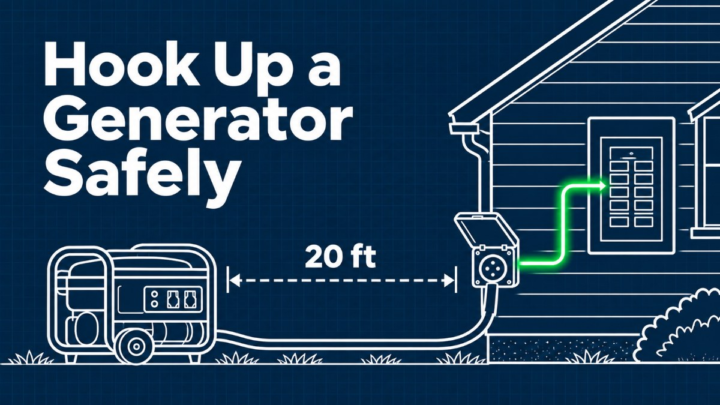
- Set up the generator outdoors, at least 20 feet from the house, with the exhaust pointed away from doors and windows.
- Turn off the main breaker and most branch breakers.
- Slide the interlock plate so the main is locked off and the generator breaker can be switched on.
- Plug the cord into the generator and the inlet, start the generator, then turn on the generator breaker.
- Turn on circuits one at a time, starting with the biggest loads (well pump, furnace), and keep the total under the generator’s rated watts.
- When power returns, turn off the generator breaker, slide the plate back, turn the main on, then shut off and unplug the generator.
Never run a generator in a garage or near open windows, and keep a battery-powered CO alarm running inside. Never try to power the house by plugging a generator into a wall outlet.
Related: How to hook up a generator to your house safely · Generator transfer switch guide · Best generator for home backup
Frequently asked questions
Is a generator interlock kit legal?
In most of the US, yes, when the kit is listed for your panel and installed under the National Electrical Code with the required breaker retainer and labels. Local rules vary, so have your electrician confirm with your inspector.
Can I install an interlock kit myself?
Mounting the plate is simple, but installing the backfeed breaker, the inlet box and the wiring is work inside your main panel. Most areas require a licensed electrician and a permit.
Will an interlock kit fit any panel?
No. Kits are made for specific brands, models and amp ratings, and the panel needs a free slot next to the main breaker. Check the label inside your panel door.
Is an interlock safer than a transfer switch?
Both prevent backfeeding when installed correctly. A transfer switch limits you to pre-wired circuits, which makes overloading less likely; an interlock gives you the whole panel but relies on you to manage the load.
What size generator breaker do I need?
Match the breaker and inlet to your generator’s largest 240-volt outlet: 30 A for an L14-30 outlet (about 7,500 W), or 50 A for a 14-50 or CS6365 outlet (about 12,000 W).
Sources: interlock parts, operating steps and kit prices from DuroMax’s interlock guide; installed-cost ranges from HomeGuide; background from Consumer Reports. Checked November 2026.