HomePowerIQ is reader-supported. When you buy through links on our site, we may earn a commission at no extra cost to you. As an Amazon Associate we earn from qualifying purchases. Our picks are based on specs, prices and published data, never on payment. How we make money.
On this page
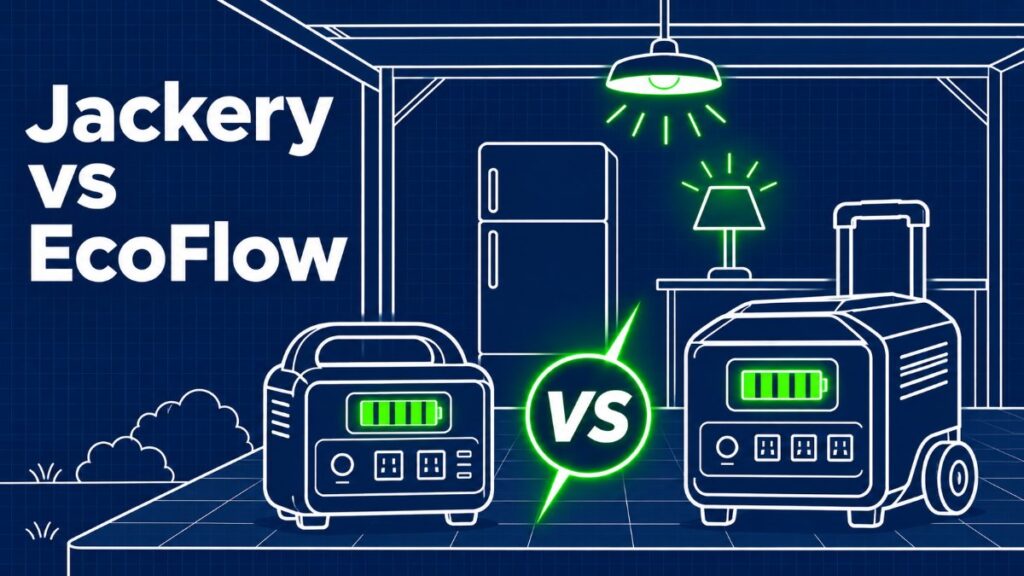
Short answer: choose EcoFlow if you want more output, faster charging and a system you can expand into whole-home backup. Choose Jackery if you want the lightest, simplest power station for the money. For home backup, the EcoFlow DELTA Pro 3 and Jackery Explorer 5000 Plus are each brand’s best pick. At the 2 kWh size, the Jackery Explorer 2000 v2 is the lighter choice and the EcoFlow DELTA 3 Plus is the better budget unit to grow over time.
How we compared: we compared each brand’s current models using manufacturer specs for capacity, output, expandability, weight and home backup features. We have not hands-on tested these units. Prices change often, so check before you buy.
Jackery vs EcoFlow at a glance
| Jackery | EcoFlow | |
|---|---|---|
| Strength | Light, simple, easy to use | More power, faster charging, more features |
| Battery type | LiFePO4 across current models | LiFePO4 across current models |
| Expandable? | Larger models only | Most DELTA models |
| Home backup flagship | Explorer 5000 Plus | DELTA Pro 3 and DELTA Pro Ultra |
| Whole-home integration | Smart transfer switch | Smart Home Panel 2 |
| Best for | Essentials backup, camping, simple setups | Growing systems, 240V loads, solar-heavy setups |
Home backup models: Explorer 5000 Plus vs DELTA Pro 3
| Spec | Jackery Explorer 5000 Plus | EcoFlow DELTA Pro 3 |
|---|---|---|
| Capacity | 5,040 Wh | 4,096 Wh |
| AC output | 7,200 W | 4,000 W (8,000 W surge) |
| 240V output | Yes | Yes |
| Solar input | Up to 4,000 W | Up to 2,600 W |
| Expansion | Up to 60 kWh with two units | Extra batteries, up to three units in parallel |
| Weight | About 134.5 lb | About 113.5 lb |
For whole-home style backup, the Jackery has more battery and more output in one box, while the EcoFlow is lighter, charges faster from the wall and has the deeper accessory ecosystem. If you need to run several 240V loads at once, the Jackery’s 7,200 W is the bigger advantage. If you want to start smaller and build up, EcoFlow gives you more ways to expand. Read our full EcoFlow DELTA Pro 3 review.
Jackery Explorer 5000 Plus
- Capacity: 5,040 Wh LFP
- Output: 7,200 W
- Voltage: 120V / 240V
- Solar input: up to 4,000 W
- Expandable: to 60 kWh with two units
The Explorer 5000 Plus is Jackery’s answer to whole-home backup. It runs large 240V appliances and recharges quickly with a big solar array.
What we like
- Most capacity and output in one unit
- Highest solar input in this comparison
- Pairs with Jackery smart transfer switch
Watch out for
- About 134.5 lb
- More than most essentials-only homes need
EcoFlow DELTA Pro 3
- Capacity: 4,096 Wh LFP
- Output: 4,000 W (8,000 W surge)
- Voltage: 120V / 240V
- Solar input: up to 2,600 W
- Expandable: up to 12 kWh per unit
The DELTA Pro 3 is the more balanced, easier-to-move home backup unit, and it plugs into EcoFlow’s wider system of batteries and smart panels.
What we like
- Lighter than the Jackery 5000 Plus
- 0 to 80% in about 50 minutes
- Works with EcoFlow Smart Home Panel 2
Watch out for
- Less output than the Jackery
- EcoFlow-only accessories
2 kWh models: Explorer 2000 v2 vs DELTA 3 Plus
| Spec | Jackery Explorer 2000 v2 | EcoFlow DELTA 3 Plus |
|---|---|---|
| Capacity | 2,042 Wh | 1,024 Wh, expandable to 5 kWh |
| AC output | 2,200 W (4,400 W surge) | 1,800 W (3,600 W surge) |
| Expandable? | No | Yes |
| Weight | About 39.5 lb | Lighter base unit, heavier once expanded |
| Best for | Overnight essentials in one light box | Starting small and adding batteries later |
These two solve the same problem in different ways. The Jackery gives you a full 2 kWh, enough to run a fridge and Wi-Fi overnight, in a light single box. The EcoFlow starts at half the capacity but lets you add batteries later, up to 5 kWh. If you want one simple purchase, get the Jackery. If you want to spread the cost out, get the EcoFlow.
Jackery Explorer 2000 v2
- Capacity: 2,042 Wh LFP
- Output: 2,200 W (4,400 W surge)
- Voltage: 120V
- Expandable: no
A strong pick if you want a full 2 kWh without buying into a larger system.
What we like
- Light for its capacity
- Simple to use
- Enough for a fridge and essentials overnight
Watch out for
- Not expandable
- No 240V
EcoFlow DELTA 3 Plus
- Capacity: 1,024 Wh LFP
- Output: 1,800 W (3,600 W surge)
- Voltage: 120V
- Expandable: up to 5 kWh
Start small and expand. Good for apartments and for anyone who wants to test battery backup before spending more.
What we like
- Low starting price
- Add batteries as your needs grow
- Fast switchover for routers and computers
Watch out for
- Small base battery
- No 240V
Which brand should you buy?
- For whole-home or 240V backup: Jackery Explorer 5000 Plus if you want maximum power in one box, EcoFlow DELTA Pro 3 if you want a lighter unit and a bigger accessory system.
- For fridge and essentials overnight: Jackery Explorer 2000 v2.
- For a small budget that grows later: EcoFlow DELTA 3 Plus.
- For solar-heavy setups: either brand’s flagship, sized with our solar generator guide.
Also consider Anker SOLIX and BLUETTI, which we include in our best portable power station for home backup picks. To find the size you need, try our backup power calculator.
Frequently asked questions
Is Jackery or EcoFlow better?
Neither is better in every way. EcoFlow generally offers more output, faster charging and more expansion. Jackery is usually lighter and simpler. For home backup, compare specific models like the Jackery Explorer 5000 Plus and EcoFlow DELTA Pro 3.
Which lasts longer, Jackery or EcoFlow?
Both use LiFePO4 batteries in their current models, rated for thousands of charge cycles, roughly a decade of normal use. Runtime depends on capacity, not brand.
Can Jackery or EcoFlow power a house?
Their largest models can back up many circuits, including some 240V appliances, through a transfer switch or the maker’s smart panel. Smaller models are best for a fridge, lights, Wi-Fi and medical devices.
Are EcoFlow and Jackery batteries interchangeable?
No. Each brand’s expansion batteries, panels and home integration only work with its own power stations. Standard solar panels with compatible connectors and voltage can work with both.
Is Bluetti better than Jackery or EcoFlow?
BLUETTI often offers more capacity per dollar, especially around 2 kWh. EcoFlow leads on features and Jackery on weight.