On this page
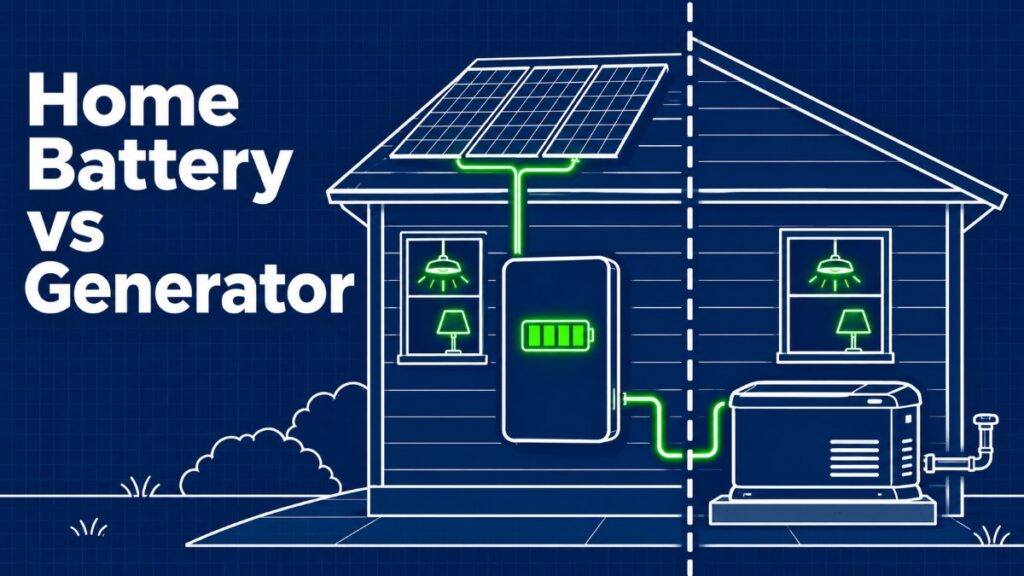
Short answer: a generator is the better choice for long outages and heavy loads, because it runs as long as it has fuel and costs less up front. A home battery is better for short, frequent outages, for quiet and hands-off backup, and for homes with solar, where it also lowers your power bill. Many homeowners use both: a battery for everyday outages and a generator for the rare multi-day storm.
How we compared: we used published installed-cost data, manufacturer specs and typical home energy use. Costs are national ranges as of November 2026 and vary by region.
Battery vs generator at a glance
| Home battery | Standby generator | Portable generator | |
|---|---|---|---|
| Typical cost | $13,000 to $17,500 installed (Powerwall-class); $3,000 to $6,000 for plug-in systems | $8,000 to $16,000 installed | $500 to $2,500, plus $500 to $2,000 to connect |
| How long it runs | About a day on one 13.5 kWh battery, longer with solar | As long as fuel lasts | As long as you refuel it |
| Switchover | Automatic, in milliseconds | Automatic, in seconds | Manual |
| Noise | Silent | Loud, like a lawn mower | Loud |
| Fuel | None (grid or solar) | Natural gas or propane | Gasoline, propane or both |
| Maintenance | Very little | Yearly service and oil changes | Oil changes, fuel storage |
| Safe indoors? | Yes | Outdoors only | Outdoors only, far from windows |
| Saves money day to day? | Yes, with solar or time-of-use rates | No | No |
Cost sources: Tesla Powerwall cost, Generac generator cost and whole house generator cost.
When a generator is the better choice
- Your outages last days. Ice storms, hurricanes and wildfire shutoffs can last a week. A natural gas standby generator keeps going the whole time.
- You run big loads. Central AC, electric heat, an electric range and a well pump all at once need 20 kW or more, which takes several batteries.
- You want the lowest cost per watt. A 22 to 24 kW standby generator costs about the same as one Powerwall 3 and covers far more load.
- You don’t have solar. Without panels, a battery has no way to recharge during a long outage.
See our best generator for home backup picks, and inverter vs regular generators if you are going portable.
When a home battery is the better choice
- Your outages are short and frequent. A battery covers most outages of a few hours with no noise and nothing to start.
- You have or want solar. Panels can refill the battery every day, and the battery saves money by storing cheap power for expensive evening hours.
- You can’t run a generator safely. In townhomes, condos and tight lots, exhaust and noise rules can make a generator impractical.
- You want zero maintenance. No oil changes, no fuel and no yearly service calls.
Compare systems in our best whole-house battery backup guide. For a lower-cost battery route, see the best portable power stations and best solar generators.
What about running costs?
A standby generator uses fuel only when it runs, but it also runs a short weekly self-test and needs yearly service, usually a few hundred dollars. A battery has almost no running cost, and with solar it can pay you back through lower bills. Over 10 years, a battery paired with solar often costs less to own than its sticker price suggests. A generator that rarely runs costs mostly its upfront price plus service.
One change to know about: the federal 30% tax credit for home batteries ended for systems installed after December 31, 2025. Generators never qualified for it. Some states and utilities still offer battery incentives.
The hybrid option: battery plus generator
You don’t have to pick just one. Common combinations:
- A home battery for instant, silent backup, plus a small portable generator to recharge it during a long outage. Units like the Anker SOLIX F3800 Plus can recharge directly from a 240V gas generator.
- A power station on a transfer switch or interlock kit for short outages, plus a portable generator on the same inlet for long ones.
- Solar plus a battery for daily savings, with a standby generator kept for rare emergencies.
How to decide
| If this sounds like you | Go with |
|---|---|
| Outages of a few hours, several times a year | Home battery or power station |
| Multi-day outages from storms or ice | Standby generator |
| Solar panels already on the roof | Home battery |
| Tight budget, essentials only | Portable generator or power station |
| Well pump, central AC and electric heat | Standby generator, or several batteries |
| Townhome or HOA limits on noise and exhaust | Home battery |
Not sure how much power you need? Run your appliances through our generator and battery size calculator.
Frequently asked questions
Is a home battery better than a generator?
For short outages, quiet operation and homes with solar, yes. For long outages and heavy loads, a generator is usually better and cheaper.
How long will a home battery last during a power outage?
One 13.5 kWh battery like the Tesla Powerwall 3 runs essentials for about a day. With solar panels it can recharge each day and last through a long outage in good weather.
Is a Powerwall cheaper than a Generac?
No. A single Powerwall 3 costs about $13,000 to $16,500 installed, while a Generac standby generator costs about $8,000 to $16,000 installed and covers more load. The Powerwall can save money day to day if you have solar.
Can I use a battery and a generator together?
Yes. Many systems let a generator recharge the battery during long outages, giving you silent backup most of the time and unlimited runtime when you need it.
Which needs less maintenance, a battery or a generator?
A battery. It needs almost no maintenance, while a standby generator needs yearly service and runs regular self-tests.