On this page
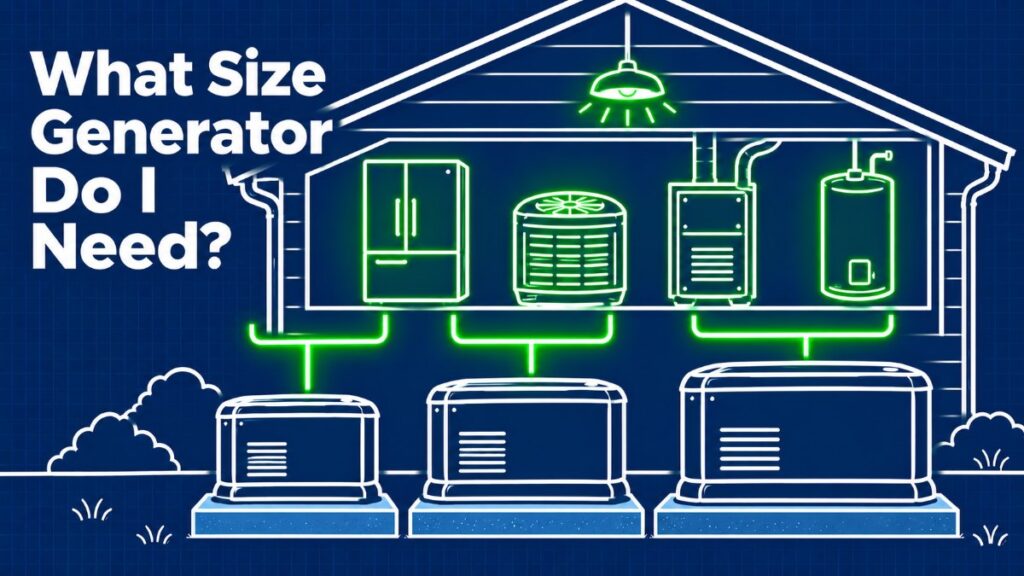
Short answer: to run essentials (fridge, furnace, lights, sump pump, internet) you need about 5,000 to 7,500 watts, which a large portable generator can cover. To run a typical whole house, including central AC, you need about 20,000 to 24,000 watts (20 to 24 kW). Big all-electric homes may need 26 kW or more. Add up your own loads with our generator size calculator to be sure.
How to use this guide: wattages below are typical ranges for common appliances. Your appliances may differ, so check nameplates or the owner’s manual, and have an electrician confirm sizing for a standby generator.
Generator size chart by goal
| What you want to run | Generator size | Type |
|---|---|---|
| Fridge, lights, phones, internet | 2,000 to 3,500 W | Small inverter or power station |
| Essentials: fridge, freezer, furnace blower, sump pump, lights, outlets | 5,000 to 7,500 W | Large portable with transfer switch |
| Essentials plus a well pump or window AC | 7,500 to 10,000 W | Large portable or 10 kW standby |
| Essentials plus central AC up to about 3 tons | 14 to 18 kW | Standby |
| Whole house, everything on, 2,000 to 3,500 sq ft | 20 to 24 kW | Standby |
| Large or all-electric home, multiple AC units | 24 to 26 kW or more | Standby, possibly liquid-cooled |
Generator size by house size
| Home size | Typical whole-house standby size |
|---|---|
| Under 1,500 sq ft | 10 to 14 kW |
| 1,500 to 2,500 sq ft | 14 to 20 kW |
| 2,500 to 3,500 sq ft | 20 to 24 kW |
| 3,500 to 5,000 sq ft | 24 to 26 kW |
| Over 5,000 sq ft | Liquid-cooled, 30 kW and up |
Square footage is only a starting point. A small home with electric heat and an electric range can need more power than a larger home with gas appliances.
Appliance wattage chart
| Appliance | Typical running watts | Notes |
|---|---|---|
| Refrigerator | 100 to 800 W | Starting surge is higher; see fridge watts |
| Chest freezer | 100 to 500 W | |
| Furnace blower (gas furnace) | 300 to 800 W | Needed for heat even with gas |
| Sump pump (1/2 hp) | 800 to 1,050 W | Surge at startup |
| Well pump (1 hp) | 1,000 to 2,000 W | Often 240V; big surge |
| Central AC (3 ton) | 3,500 to 5,000 W | Very high starting surge; soft starters help |
| Window AC | 500 to 1,500 W | |
| Electric water heater | 4,500 W | 240V |
| Electric range or oven | 3,000 to 5,000+ W | 240V |
| Electric dryer | 5,000 W | 240V |
| Microwave | 1,000 to 1,500 W | |
| Lights, TV, internet, chargers | 500 to 1,000 W | Combined |
| Level 2 EV charger | 7,000 to 11,500 W | Usually not run on backup |
How to size a generator in 4 steps
- List what must run during an outage. Be honest: most families need heat or AC, the fridge, water and internet.
- Add the running watts of everything that could run at the same time.
- Add the biggest starting surge. Motors like AC compressors and well pumps briefly draw two to three times their running watts. Add the largest one on top.
- Add about 20% headroom and adjust for fuel: standby generators make about 10% less power on natural gas than on propane.
Our generator size calculator does this math for you.
Example: a 2,400 sq ft home
Fridge (700 W) + freezer (300 W) + gas furnace blower (600 W) + 3-ton central AC (4,000 W) + well pump (1,500 W) + lights, TV and internet (800 W) + microwave (1,200 W) comes to about 9,100 running watts. Add the AC’s starting surge of roughly 8,000 W on top and about 20% headroom, and you land around 20 kW. That points to a 20 to 22 kW standby generator, like the Generac Guardian 22 kW, or a 14 to 18 kW unit with load management.
Load management: a smaller generator for the whole house
Load management modules and smart transfer switches turn big loads like AC and electric water heaters on and off in turn, so a smaller generator can cover the whole house without overloading. It is a common way to save $1,000 or more. Champion’s aXis system and Generac’s load-shedding switches both do this. Compare options in best whole house generators.
Portable or standby?
Up to about 10,000 watts, a portable generator with a interlock kit is the budget route; see best backup generator for home. Above that, or if you want automatic power, you are in standby territory. Our Generac home generators guide lists what each standby size covers.
Frequently asked questions
What size generator do I need to run my whole house?
Most homes need 20 to 24 kW to run everything at once, including central AC. Smaller homes with gas appliances may need only 14 to 18 kW, especially with load management.
Will a 10,000-watt generator run a house?
It will run essentials, including a fridge, furnace blower, well pump, lights and outlets, but usually not central AC along with everything else.
What size generator do I need for a 2,000 sq ft house?
Typically 14 to 20 kW for whole-house standby power, depending on your AC, heating and cooking fuel.
What size generator do I need to run central air?
A 3-ton central AC usually needs a 14 kW or larger standby generator once you include the rest of your essentials and the compressor’s starting surge. A soft starter can reduce the surge.
Is it better to oversize a generator?
A little headroom, about 20%, is smart. Going much bigger raises the purchase price and fuel use without adding real benefit.