HomePowerIQ is reader-supported. When you buy through links on our site, we may earn a commission at no extra cost to you. As an Amazon Associate we earn from qualifying purchases. Our picks are based on specs, prices and published data, never on payment. How we make money.
On this page
Short answer: the EcoFlow DELTA Pro 3 is one of the best single-unit home backup power stations you can buy. It stores 4,096 Wh, puts out 4,000 W at 120V or 240V, takes up to 2,600 W of solar and can grow with extra batteries. It is worth it if you want to back up a fridge, furnace and well pump through a transfer switch. It is too heavy and too expensive if you only need to charge phones and run a few lights.
How we reviewed it: this is a research-based review. We worked from EcoFlow’s published specs, retailer spec sheets and our own runtime math, and we compared it with its closest rivals. We have not hands-on tested this unit.
EcoFlow DELTA Pro 3
- Capacity: 4,096 Wh LFP (4,000 cycles to 80%)
- Output: 4,000 W (8,000 W surge)
- Voltage: 120V / 240V
- Solar input: up to 2,600 W
- Weight: about 113.5 lb
The DELTA Pro 3 sits between a camping power station and a permanent home battery. It is big enough to back up the circuits that matter most and still mobile enough to roll out to the garage or job site.
What we like
- Real 240V output from one unit
- Fast charging, 0 to 80% in about 50 minutes
- Expands with extra batteries and smart home panels
Watch out for
- Heavy, needs its built-in wheels
- List price around $3,699, though sales are common
Key specs
| Spec | EcoFlow DELTA Pro 3 |
|---|---|
| Battery | 4,096 Wh LiFePO4, rated for 4,000 cycles to 80% capacity |
| AC output | 4,000 W continuous, 8,000 W surge |
| Voltage | 120V and 240V |
| Outlets | Four 120V 5-20R, one TT-30, one 240V L14-30, one 240V 6-20, plus USB-A, USB-C and DC |
| Solar input | Two inputs, up to 2,600 W combined |
| Fast charging | 0 to 80% in about 50 minutes with X-Stream |
| Expansion | Extra batteries, and up to three units linked in parallel |
| Switchover | Under 10 ms as a UPS |
| Weight and size | About 113.5 lb, 27.3 x 16.2 x 13.4 in |
Specs from B&H’s DELTA Pro 3 spec sheet and EcoFlow, November 2026.
How long will the DELTA Pro 3 run your house?
After inverter losses, plan on roughly 3,400 to 3,500 Wh of usable AC power from a full charge. Here is what that means in practice:
| What you run | Typical daily use | Estimated runtime |
|---|---|---|
| Modern refrigerator only | 1 to 2 kWh | About 2 to 3 days |
| Fridge, Wi-Fi, lights and phones | About 2.5 kWh | About 1.5 days |
| Essentials plus a CPAP | About 3 kWh | About 1 day |
| Essentials with 2 extra batteries (12 kWh total) | About 3 kWh | About 3.5 days |
| Essentials with 1,600 W of solar on sunny days | About 3 kWh | Indefinitely, weather permitting |
Estimates use average daily energy, not peak watts. Check your own loads with our backup power calculator, and see how many watts a refrigerator uses for fridge numbers.
What we like
- True 240V from one box. Most power stations in this size need two units linked together for 240V. The DELTA Pro 3 does it alone, so it can run a well pump or other 240V circuits through a transfer switch.
- Fast recharging. Wall charging to 80% in under an hour means you can top it off quickly when a storm is coming.
- Room to grow. Start with one unit, then add extra batteries or EcoFlow’s Smart Home Panel 2 for automatic whole-home switchover.
- Long battery life. LiFePO4 cells rated for thousands of cycles should last about a decade of normal use.
What to know before you buy
- It is heavy. At about 113.5 lb, it rolls well on flat floors but is a two-person lift into a truck.
- 4,000 W continuous is the real limit. It can surge higher to start motors, but central AC without a soft starter may still be too much.
- The full system costs more than the box. Extra batteries, panels and a smart panel or transfer switch add up quickly.
- It locks you into EcoFlow. Its expansion batteries and home panels only work with EcoFlow gear.
DELTA Pro 3 vs the alternatives
| Model | Capacity | Output | 240V? | Best for |
|---|---|---|---|---|
| EcoFlow DELTA Pro 3 | 4,096 Wh | 4,000 W | Yes | Balanced home backup |
| Anker SOLIX F3800 Plus | 3,840 Wh | 6,000 W | Yes | More output for 240V loads |
| Jackery Explorer 5000 Plus | 5,040 Wh | 7,200 W | Yes | More capacity in one unit |
| EcoFlow DELTA Pro Ultra | 6,144 Wh per battery | 7,200 W | Yes | Semi-permanent whole-home system |
If you need more output for big 240V appliances, the Anker SOLIX F3800 Plus is the stronger pick. If you mainly want the most battery for the money, look at the Jackery Explorer 5000 Plus, which we cover in Jackery vs EcoFlow. For a system that stays mounted in the garage, see our guide to whole-house battery backup.
How to hook it up to your home
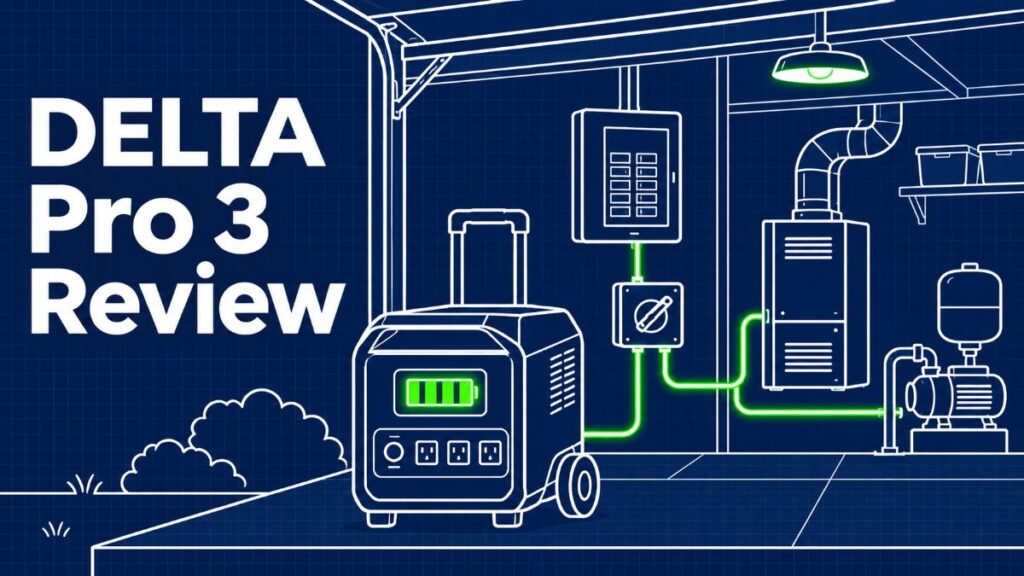
For a few appliances, extension cords work. To power hardwired circuits like a furnace or well pump, you need a transfer switch or an interlock kit and an inlet box, installed by a licensed electrician. The L14-30 outlet on the DELTA Pro 3 is the same plug most home generator inlets use, so the setup works much like hooking up a generator, without the exhaust.
Who should buy the DELTA Pro 3
Buy it if you have outages a few times a year, want to keep the fridge, heat and internet running without a gas generator, and can store a 113 lb unit in the garage or a closet. Skip it if you only need phone charging and lights (a 1 to 2 kWh unit from our best portable power station list costs far less) or if you want hands-off, permanent backup for the whole house, where a standby generator or wall battery fits better.
Frequently asked questions
How long does the EcoFlow DELTA Pro 3 last in a power outage?
About a day running essentials like a fridge, Wi-Fi, lights and a CPAP, or 2 to 3 days running just a refrigerator. Extra batteries and solar panels extend that.
Can the DELTA Pro 3 run central air conditioning?
Some smaller central AC units can run within its 4,000 W limit, especially with a soft starter. Larger systems will overload it or drain it within a few hours.
How much does the DELTA Pro 3 weigh?
About 113.5 lb. It has built-in wheels and a pull handle.
Can I charge the DELTA Pro 3 with solar panels?
Yes. It has two solar inputs that take up to 2,600 W combined. See our best solar generator guide for panel sizing.
Is the DELTA Pro 3 better than the DELTA Pro Ultra?
They serve different needs. The DELTA Pro 3 is a single portable unit. The DELTA Pro Ultra is a modular, semi-permanent system with more output and much more expansion room, at a higher price.