HomePowerIQ is reader-supported. When you buy through links on our site, we may earn a commission at no extra cost to you. As an Amazon Associate we earn from qualifying purchases. Our picks are based on specs, prices and published data, never on payment. How we make money.
On this page
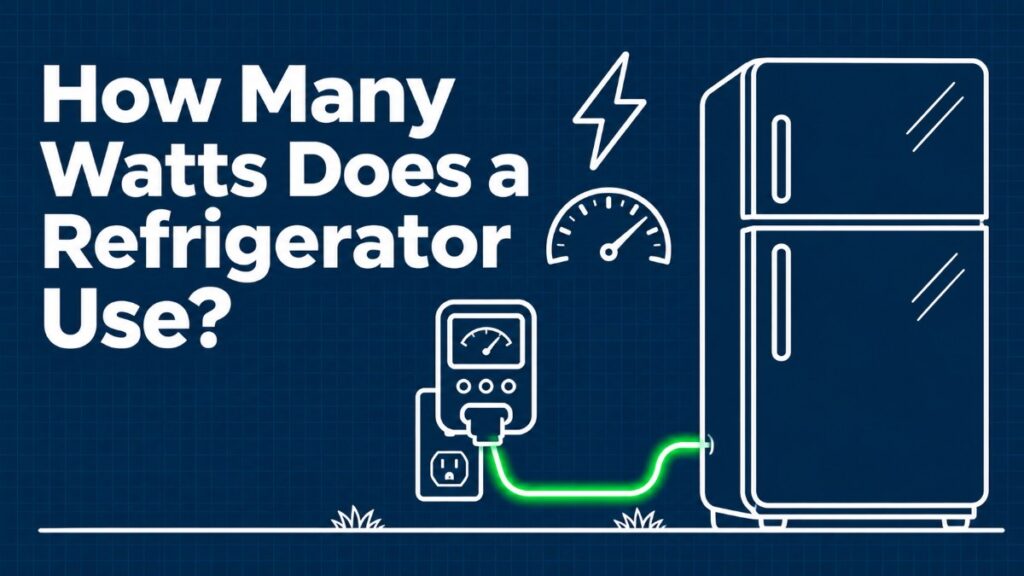
Short answer: a typical modern refrigerator draws about 100–400 watts while the compressor runs and needs a brief starting surge of roughly 800–1,200 watts (more for large or older models). Because it cycles on and off, it averages far less: a new ENERGY STAR full-size fridge uses around 360 kWh a year, or about 1 kWh a day. For generator sizing, plan on 700 running and 2,200 starting watts to be safe.
Refrigerator wattage by type
| Refrigerator type | Running watts (compressor on) | Starting watts (surge) | Typical energy use |
|---|---|---|---|
| Mini fridge | 50–100 W | 200–400 W | About 200–400 kWh/yr |
| Modern full-size (ENERGY STAR) | 100–250 W | 600–1,200 W | About 360 kWh/yr (≈1 kWh/day) |
| Side-by-side or French door | 150–400 W | 800–1,500 W | About 500–800 kWh/yr |
| Older fridge (1990s) | 300–700 W | 1,500–2,200 W | 1,000+ kWh/yr |
| Chest freezer (ENERGY STAR) | 50–150 W | 300–800 W | About 215 kWh/yr |
Ranges compiled from the sources below; your model’s EnergyGuide label and nameplate are the best numbers to use.
Running watts vs starting watts
Your fridge’s compressor needs a short burst of extra power to start, usually two to three times its running draw. That surge only lasts a second or two, but your generator, power station or battery must be able to supply it, or the fridge won’t start.
That’s why generator sizing charts use conservative numbers like 700 running / 2,200 starting watts for a refrigerator: it covers most full-size and older models. Our generator size calculator uses these values and adds in your other appliances.
How to find your fridge’s exact wattage
- Check the nameplate sticker inside the fridge or on the back. If it lists amps, multiply by 120 volts (for example, 6 A × 120 V = 720 W rated).
- Check the yellow EnergyGuide label for annual kWh. Divide by 365 for daily kWh.
- Use a plug-in watt meter for a day to measure real use, including defrost cycles.
A common rule of thumb is that average running wattage is about one-third of the nameplate rating, because the compressor cycles on and off.
See today's pricePlug-in watt meters
What can power a refrigerator during an outage?
| Backup option | Will it run a fridge? | Notes |
|---|---|---|
| 2,000–3,000 W inverter generator | Yes | Enough for a fridge plus lights and chargers; see inverter vs regular generators |
| 1,000–2,000 Wh portable power station | Yes, for about 1–2 days | Check the surge rating covers the compressor start |
| Home battery (10+ kWh) | Yes, for several days | Usually paired with solar |
| Car inverter | Not recommended | Most can’t handle the starting surge |
To estimate power station runtime: daily kWh ÷ 0.85 (inverter losses). A fridge using 1.2 kWh a day needs about 1.4 kWh of battery per day of backup.
See today's price2,000 Wh power stations
Tips to keep food cold longer in an outage
- Keep the doors closed. Per the USDA, an unopened fridge keeps food cold for about 4 hours, and a full freezer holds its temperature for about 48 hours (24 if half full).
- Run the fridge on a generator for a few hours at a time if fuel is tight; it will hold temperature in between.
- Keep the fridge at 40°F or below and the freezer at 0°F or below, with an appliance thermometer in each.
Related: Best portable power station for home backup · Best generator for home backup
Frequently asked questions
How many watts does a refrigerator use per hour?
A modern fridge averages roughly 40–60 watts over a full day because it cycles. While the compressor runs, it draws about 100–400 W.
Can a 2,000-watt generator run a refrigerator?
Usually yes for a modern fridge, as long as little else is running when it starts. Older or larger fridges may need 3,000 W or more for the start.
How many watts does a fridge and freezer need together?
Plan on about 1,200 running watts and enough surge for the larger compressor start, roughly 2,500–3,000 watts total for a generator.
Does a refrigerator need a pure sine wave inverter?
Yes. Use a pure sine wave inverter, power station or inverter generator to protect the compressor motor and control board.
Sources: EnergySage: how many watts does a refrigerator use; GreenCalculus refrigerator electricity guide (ENERGY STAR data); PickNRG refrigerator power use; USDA: keeping food safe during emergencies. Checked November 2026.