HomePowerIQ is reader-supported. When you buy through links on our site, we may earn a commission at no extra cost to you. As an Amazon Associate we earn from qualifying purchases. Our picks are based on specs, prices and published data, never on payment. How we make money.
On this page
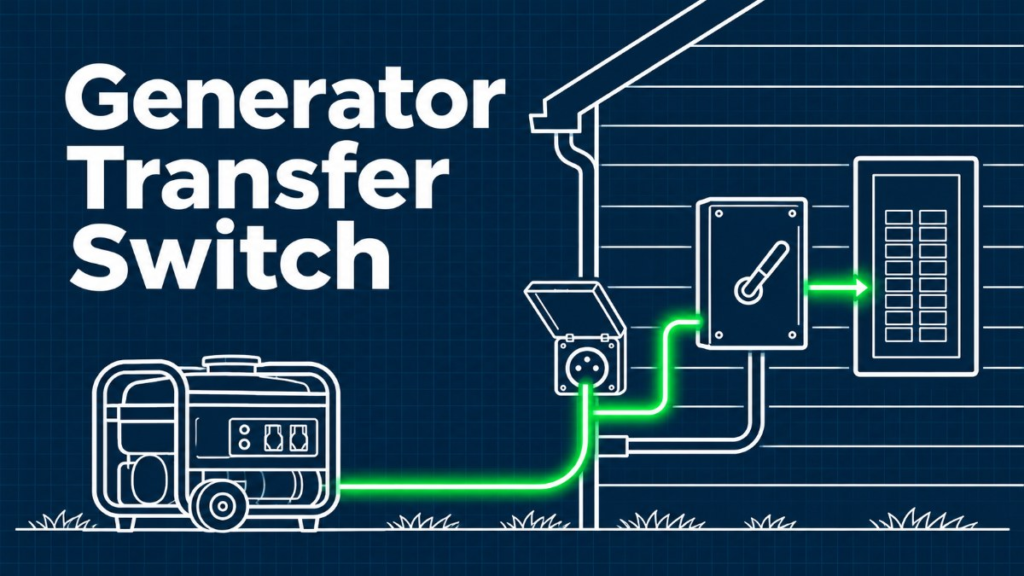
Short answer: a generator transfer switch is a small panel, installed next to your breaker box, that lets you power selected home circuits from a portable generator without backfeeding the utility lines. A manual switch costs about $400–$1,300 installed; an automatic one runs about $600–$2,500. Most portable generators up to about 7,500 W pair with a 30-amp switch; larger ones need 50 amps.
Plugging a generator into a wall outlet with a “suicide cord” can send power back up the line to utility workers and can start a fire. A transfer switch, or a panel interlock kit, is the safe, code-approved way to connect. This guide covers how each type works, what it costs, which size you need and what to ask your electrician.
What a transfer switch does
Your house normally gets power from the utility. A transfer switch adds a second source, your generator, and makes sure the two can never be connected at the same time. When the power goes out, you flip the circuits you care about (fridge, furnace, sump pump, a few outlets) from “Line” to “Gen,” start the generator, and those circuits run from the generator through a heavy cord and an outdoor inlet box.
Because the generator plugs into an inlet on the outside wall, you never run extension cords through windows or doors, and hardwired loads like a furnace or well pump become usable during an outage.
Types: manual, automatic and interlock kits
| Option | How it works | Best for | Installed cost |
|---|---|---|---|
| Manual transfer switch | A small subpanel with switches for 6–10 chosen circuits. You flip each one to generator power. | Portable generators; powering a set list of essentials | $400–$1,300 |
| Automatic transfer switch (ATS) | Senses an outage, starts a standby generator and moves the load on its own, then switches back. | Standby (whole-house) generators | $600–$2,500 for the switch install; usually bundled into standby quotes |
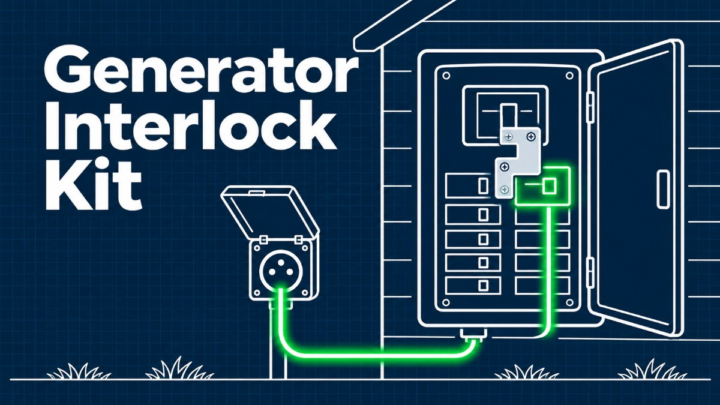
| Generator interlock kit | A sliding plate on your main panel that blocks the main breaker from being on while the generator breaker is on. | Portable generators when you want to choose any circuit in the panel | $400–$850 |
An interlock is not technically a transfer switch, but it does the same safety job. It needs a kit listed for your exact panel model, and some local inspectors don’t accept them. Your electrician will know your area’s rules. See our interlock kit guide for the details.
How much does a transfer switch cost?
| Item | Typical cost |
|---|---|
| Manual transfer switch kit (switch, inlet box, cord) | $300–$500 |
| Manual transfer switch, installed | $400–$1,300 |
| Interlock kit, installed | $400–$850 |
| Automatic transfer switch, installed | $600–$2,500 |
| Permit and inspection | Varies by city; often under $200 |
What moves the price: the switch’s amperage (30 A vs 50 A), how many circuits it handles, how far the inlet box sits from your panel, whether your panel has room and is in good shape, and local electrician rates. Kits that bundle the switch, inlet box and cord usually cost less than buying parts separately.
Generator not bought yet? Use our generator size calculator first. The size of your generator decides whether you need a 30-amp or 50-amp switch.
30-amp or 50-amp: which size do you need?
Match the switch to the biggest 240-volt outlet on your generator:
- 30-amp (L14-30 twist-lock outlet): handles about 7,200–7,500 W. That fits most portable generators in the 5,000–9,500 W class.
- 50-amp (14-50 or CS6365 outlet): handles about 12,000 W, for large portables of roughly 10,000 W and up.
- Only a 20-amp outlet? Many 30-amp kits include an adapter plug for 20-amp (L14-20) generators, but you’ll be limited to about 5,000 W.
Popular manual transfer switch kits
These Reliance Controls kits are among the most widely used manual switches for portable generators. Both come with the outdoor inlet box and a 10-foot, 30-amp cord.
Reliance Controls 31406CRK
Best for: fridge, furnace fan, sump pump and a few lights
- Rating: 30 A, about 7,500 W
- Circuits: 6 (four 15 A single-pole, one 20 A double-pole)
- Generator plug: L14-30 (L14-20 adapter included)
- Includes: inlet box and 10 ft cord
The six-circuit kit covers the classic outage list. Have your electrician confirm which of your circuits fit within its 15 A and 20 A breakers.
What we like
- Complete kit in one box
- Widely stocked, so parts are easy to find
Watch out for
- Only 6 circuits
- 30 A limit (about 7,500 W)
Reliance Controls 31410CRK
Best for: larger homes or a 240 V well pump
- Rating: 30 A, about 7,500 W
- Circuits: 10 (six 15 A single-pole, two 20 A double-pole)
- Generator plug: L14-30 (L14-20 adapter included)
- Includes: inlet box and 10 ft cord
Choose this one if your must-have list doesn’t fit in six circuits, or you need to run two 240-volt loads.
What we like
- Room for more essentials
- Two 240 V circuits
Watch out for
- Costs more than the 6-circuit kit
- Still a 30 A limit, so more circuits doesn't mean more watts
How to choose the right setup
- List your must-run loads. Fridge, freezer, furnace fan, sump or well pump, lights and Wi-Fi are the usual list. Our calculator totals the watts.
- Pick the generator, then the switch. Match the switch amperage to the generator’s biggest outlet (30 A or 50 A).
- Decide: chosen circuits or the whole panel? A manual switch handles a fixed list of 6–10 circuits. An interlock lets you pick any circuit in the panel during an outage, but you have to manage the load yourself.
- Standby generator? Then you want an automatic transfer switch, sized and installed with the generator.
- Get a licensed electrician and a permit. This is wiring into your main panel; it should be permitted and inspected.
Using a manual transfer switch during an outage
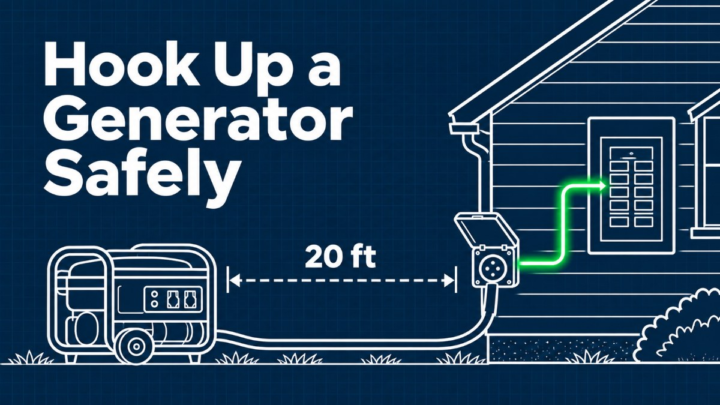
- Set up the generator outdoors, at least 20 feet from the house with the exhaust pointed away from doors and windows.
- Plug the power cord into the generator and the outdoor inlet box.
- Start the generator and let it warm up for a minute.
- Flip the transfer switch circuits from LINE to GEN one at a time, starting with the largest load (often the well pump or furnace).
- Watch the watt meters, if your switch has them, and keep the total under the generator’s rated watts.
- When utility power returns, flip each circuit back to LINE, then shut the generator off and let it cool before unplugging.
Never run a generator in a garage, basement or near open windows, even with the door open. Carbon monoxide builds up fast. Use a battery CO alarm inside the house whenever the generator is running.
Related: How to hook up a generator to your house safely · Whole house generator installation cost
Frequently asked questions
Do I need a transfer switch for a portable generator?
You need one, or an interlock kit, if you want to power anything hardwired (furnace, well pump) or connect to your home’s circuits at all. If you only run a fridge and a lamp off extension cords plugged into the generator, you don’t, but never plug the generator into a wall outlet.
Can I install a transfer switch myself?
The kits are designed to be installed by an electrician, and most areas require a permit and inspection for work in your main panel. Hiring a licensed electrician also protects your homeowner’s insurance.
How long does installation take?
A manual transfer switch or interlock is usually a half-day job for an electrician. An automatic transfer switch for a standby generator takes longer and is normally part of the whole generator install.
Is an interlock kit as safe as a transfer switch?
When it’s listed for your panel and installed correctly, an interlock prevents backfeeding just like a transfer switch. The trade-off is that you choose and manage loads at the main panel yourself, and not every jurisdiction accepts them.
What size transfer switch do I need for a 7,500 watt generator?
A 30-amp switch. At 240 volts, 30 amps covers about 7,200–7,500 W, which matches most generators in that class. Go to 50 amps for generators around 10,000 W and up.
Sources: installed-cost ranges from HomeGuide’s transfer switch cost guide; switch specifications from Reliance Controls product listings for the 31406CRK and 31410CRK; interlock background from Consumer Reports. Prices and specs checked November 2026.