HomePowerIQ is reader-supported. When you buy through links on our site, we may earn a commission at no extra cost to you. As an Amazon Associate we earn from qualifying purchases. Our picks are based on specs, prices and published data, never on payment. How we make money.
On this page
Short answer: the best whole house generator for most homes is a 20 to 24 kW air-cooled standby generator with an automatic transfer switch, running on natural gas or propane. Our picks: the Generac Guardian 22 kW (best overall), Kohler 20RESCL (best built), Champion 14 kW aXis (best value, 10-year warranty), Cummins RS20A (quiet, cold-climate pick) and the Generac Guardian 10 kW (budget essentials). Expect about $8,000 to $16,000 installed.
How we picked: we compared manufacturer specs for output on natural gas and propane, transfer switch options, sound ratings, warranty and price, then matched each to a type of home. We have not hands-on tested these generators. Prices are list or typical retail as of November 2026 and do not include installation.
Quick comparison
| Generator | Output (LP / NG) | Transfer switch | Warranty | Generator price | Best for |
|---|---|---|---|---|---|
| Generac Guardian 22 kW (7043) | 22 kW / 19.5 kW | 200 A whole-house included | 5 years | MSRP about $6,979 | Most homes |
| Kohler 20RESCL | 20 kW / 18 kW | Sold with or without 200 A switch | 5 years / 2,000 hours | About $5,700 with switch | Build quality and power quality |
| Champion 14 kW aXis | 14 kW / 12.5 kW | 100 to 200 A whole-house options | 10 years | About $4,500 to $5,000 with switch | Value and warranty |
| Cummins RS20A | About 20 kW | Sold separately or as a kit | 5 years | About $6,000 | Quiet operation, cold climates |
| Generac Guardian 10 kW (7172) | 10 kW | 16-circuit switch included | 5 years | MSRP about $4,269 | Essential circuits only |
Prices from manufacturer list prices and authorized dealer listings, November 2026. Most buyers pay an installer, and the installed price is roughly double the generator price. See our whole house generator cost guide.
What is a whole house generator?
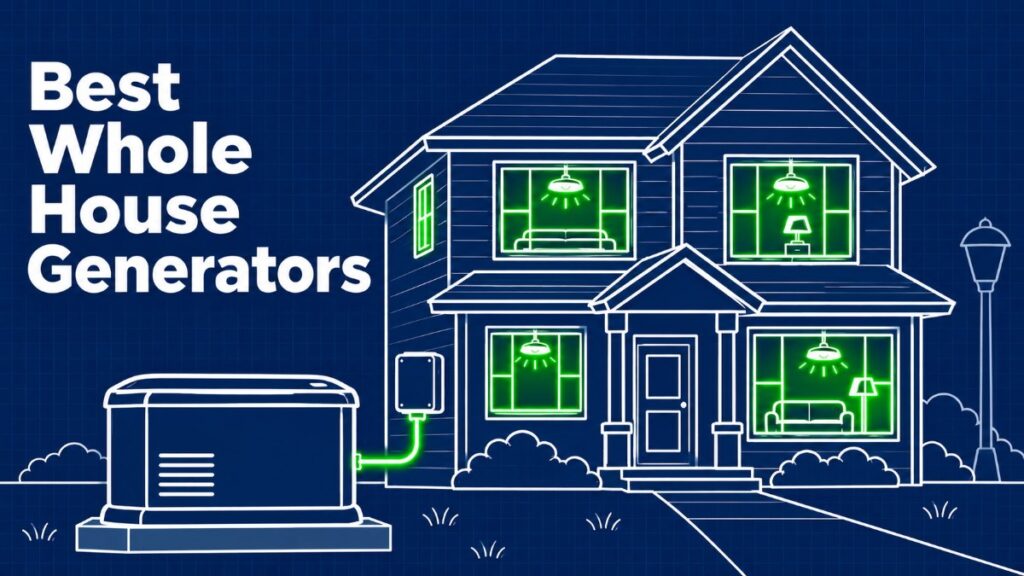
A whole house generator, also called a home standby generator, is a permanently installed generator that sits on a pad outside your home. It is wired to your electrical panel through an automatic transfer switch and runs on your natural gas line or a propane tank. When the power goes out, it starts on its own and takes over within seconds, then shuts off when the grid comes back. You don’t refuel it, roll it out or run extension cords.
That is the difference from a portable generator. A portable unit can run the essentials through an inlet box, but you have to set it up, start it and keep it fueled. If you want to compare the two, our best backup generator for home guide covers the portable side.
The best whole house generators
Generac Guardian 22 kW
- Output: 22 kW propane / 19.5 kW natural gas
- Transfer switch: 200 A whole-house (model 7043)
- Sound: about 67 dBA at normal operation
- Warranty: 5-year limited
- Wi-Fi: Mobile Link monitoring
The Guardian 22 kW is the default whole house generator for good reason. It covers central AC, a well pump, the kitchen and everything else in a typical home, the 200 A switch is included, and the Generac dealer network is the largest in the country. Read our full Generac 22kW review.
What we like
- The most popular home standby size, so parts and dealers are everywhere
- Enough power for most 2,000 to 3,500 sq ft homes
- Low-speed Quiet-Test weekly exercise
Watch out for
- Natural gas output is 2.5 kW lower than on propane
- Not the quietest in its class
Kohler 20RESCL
- Output: 20 kW propane / 18 kW natural gas
- Transfer switch: available with 200 A RXT switch
- Enclosure: corrosion-proof composite
- Warranty: 5 years or 2,000 hours
- Weight: about 500 lb
Kohler built its reputation on industrial engines, and the 20RESCL feels like it. The composite enclosure is a real plus near the ocean, and its power quality is excellent for sensitive electronics. Compare the two big brands in Generac vs Kohler.
What we like
- Excellent voltage and frequency regulation for electronics
- Enclosure will not rust in coastal air
- PowerBoost for starting big motors
Watch out for
- Smaller dealer network than Generac
- Usually costs a little more per kW
Champion 14 kW aXis
- Output: 14 kW propane / 12.5 kW natural gas
- Transfer switch: 100, 150 or 200 A whole-house options
- Load management: aXis prioritized power management
- Warranty: 10-year limited
- Weight: about 480 lb with switch
Champion’s aXis system pairs a 14 kW generator with a smart transfer switch that sheds lower-priority loads, so a smaller, cheaper unit can still cover the whole house. With a 10-year warranty, it is the best value here for homes that do not need to run everything at once.
What we like
- Longest standard warranty on the market
- Low price with a whole-house switch included
- Load management stretches a 14 kW unit across a whole house
Watch out for
- Less output than 20 kW-class units
- Smaller service network
Cummins RS20A
- Output: about 20 kW
- Series: Quiet Connect
- Cold-weather version: rated to -40°F (RS20AE)
- Warranty: 5-year limited
If noise or bitter winters are your main concern, the Cummins Quiet Connect series is the one to look at. The extreme-cold version is built for temperatures down to -40°F. See all the low-noise options in quietest standby generators.
What we like
- Among the quietest in its class
- Extreme-cold version for northern homes
- Commercial-grade engine heritage
Watch out for
- Fewer dealers than Generac
- Transfer switch often sold separately
Generac Guardian 10 kW
- Output: 10 kW
- Transfer switch: 16-circuit switch included (model 7172)
- Warranty: 5-year limited
- MSRP: about $4,269
If you mainly want the heat, fridge, sump pump and lights to stay on, a 10 kW unit with a circuit-level switch does the job for a lot less. Use our generator size calculator to check.
What we like
- Lowest-cost Generac standby system
- Covers furnace, fridge, lights, sump pump and outlets
- Smaller pad and fuel line
Watch out for
- Will not run central AC with everything else
- Not a true whole-house unit
What size whole house generator do you need?
| Home and loads | Typical size |
|---|---|
| Essentials only: furnace, fridge, lights, sump pump, outlets | 10 to 14 kW |
| Essentials plus one central AC up to about 3 tons | 14 to 18 kW |
| Most 2,000 to 3,500 sq ft homes, everything on | 20 to 24 kW |
| Large homes, multiple AC units, electric heat or cooking | 24 to 26 kW, or liquid-cooled |
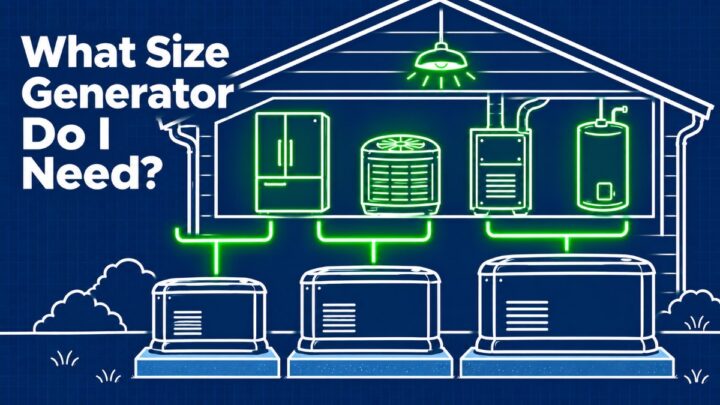
Load management modules let a smaller generator cover more of the house by switching big appliances on and off in turn. Our full guide, what size generator do I need, includes a wattage chart.
Natural gas or propane?
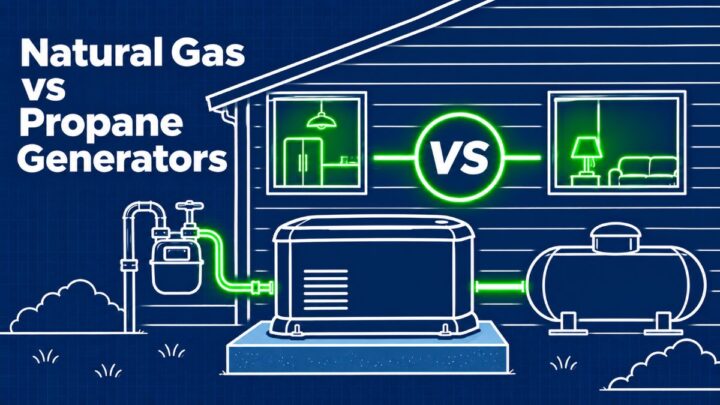
Natural gas is the easiest choice if you already have it: it never runs out and costs less per hour. Propane gives slightly more output from the same generator and works anywhere, but you need a tank, and runtime depends on its size. We break it down in natural gas vs propane generators. For homes without either, see diesel home standby generators.
What installation involves
Every whole house generator needs a licensed installer, permits and an inspection. Expect a site visit, a few weeks for permits, one to two days of work and a final inspection. Our standby generator installation guide walks through each step, and the Generac generator cost guide covers pricing.
Frequently asked questions
What is the best whole house generator?
For most homes, a 20 to 24 kW air-cooled standby generator like the Generac Guardian 22 kW. Kohler is the premium alternative, and Champion offers the best warranty for the money.
How much does a whole house generator cost?
Most homeowners pay about $8,000 to $16,000 installed, including the generator. The generator itself is usually $4,000 to $8,000, and the rest is the transfer switch, pad, fuel line, electrical work and permits.
What size generator do I need to run my whole house?
Most homes need 20 to 24 kW to run everything at once, including central AC. With load management, many homes can get by with 14 to 18 kW.
How long do whole house generators last?
With yearly maintenance, many home standby generators last 20 years or more. Most run only a few hours a year beyond their short weekly self-test, so engine hours build slowly.
Can a whole house generator run on natural gas and propane?
Most air-cooled standby generators can run on either fuel, but they are set up for one during installation. Output is usually a little higher on propane.