HomePowerIQ is reader-supported. When you buy through links on our site, we may earn a commission at no extra cost to you. As an Amazon Associate we earn from qualifying purchases. Our picks are based on specs, prices and published data, never on payment. How we make money.
On this page
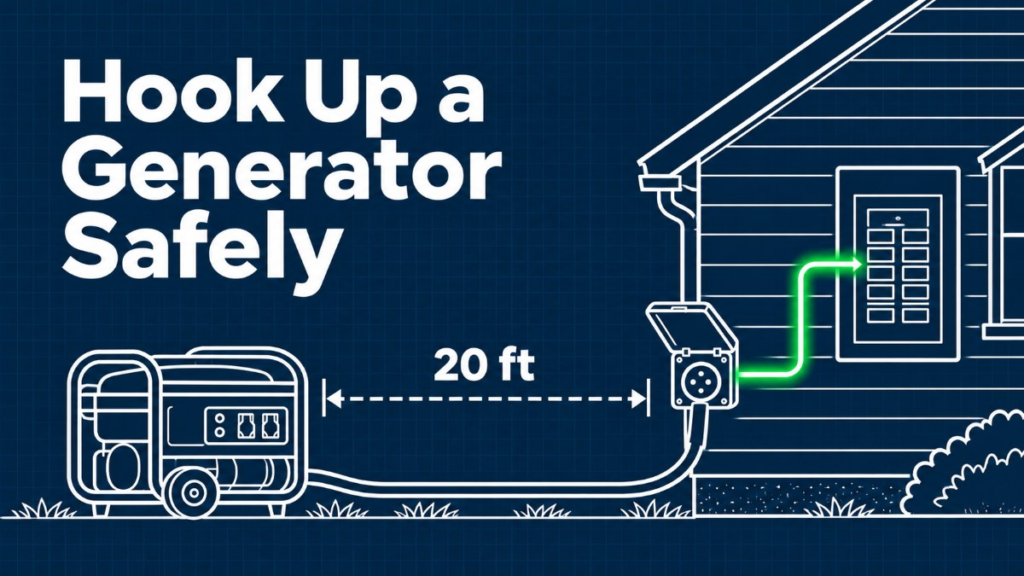
Short answer: there are three safe ways to hook up a portable generator to your house: heavy-duty extension cords to individual appliances, a manual transfer switch, or a panel interlock kit with a power inlet box. The last two should be installed by a licensed electrician. Never plug a generator into a wall outlet (backfeeding), and always run it outside, at least 20 feet from doors, windows and vents.
Never backfeed. Plugging a generator into a wall outlet with a double-male “suicide cord” can electrocute you, your family, neighbors and utility line workers, and can start a fire. The CPSC, utilities and generator makers all warn against it, and it is illegal in most places.
The 3 safe ways to connect a generator
| Method | Cost (typical) | What it powers | Best for |
|---|---|---|---|
| Extension cords | $30–$150 for cords | Plug-in appliances only (fridge, lamps, chargers) | Short outages, renters, small generators |
| Manual transfer switch | About $400–$1,300 installed | A set of chosen circuits, including hardwired ones | Homeowners who want specific circuits backed up |
| Interlock kit + inlet box | About $400–$850 installed | Any circuit in your panel, one load at a time | The most flexible, lowest-cost hardwired setup |
Costs from our transfer switch guide and interlock kit guide.
Option 1: Extension cords
The simplest method. Run outdoor-rated, heavy-gauge cords from the generator to the appliances you need. Use cords rated at least as high as the generator outlet, with all three prongs and no cuts. Don’t run cords under rugs, and protect them where they pass through a door or window.
Limitations: cords can’t power hardwired loads like a furnace, well pump or central AC, and an open door or window for the cord can let exhaust in.
Check price on AmazonOutdoor generator cords
Option 2: Manual transfer switch
A transfer switch is mounted next to your main panel and wired to the circuits you choose, typically 6 to 10. An electrician installs a power inlet box outside, and you connect the generator with a single cord. During an outage you flip each circuit from “line” to “gen.”
- Physically prevents backfeeding
- Powers hardwired circuits like a furnace blower or well pump
- Limited to the circuits wired in
Check price on AmazonManual transfer switches
Option 3: Interlock kit with an inlet box
An interlock is a sliding plate on your main panel that makes it impossible to have the main breaker and the generator breaker on at the same time. With a generator breaker and an outdoor inlet box, you can choose any circuit in the panel and switch loads as needed.
- Usually the cheapest hardwired option
- Works with any circuit, as long as the total load fits the generator
- Must be a kit listed for your exact panel model
See our interlock kit guide for how to find the right kit for your panel.
Step by step: running your generator safely
- Place the generator outdoors on dry, level ground, at least 20 feet from doors, windows and vents, with the exhaust pointed away from the house.
- Make sure working battery-powered CO alarms are inside the house.
- Start the generator with nothing connected and let it warm up.
- If you use a transfer switch or interlock: turn off the main breaker (or set the switch), connect the generator cord to the inlet box, then turn on the generator breaker and your circuits one at a time, biggest loads first.
- If you use cords: plug in appliances one at a time.
- Watch the total load. Use our generator size calculator to see what your generator can run.
- To refuel, shut the generator off and let it cool first.
- When power returns, turn off generator circuits and the generator breaker, then turn the main breaker back on before shutting down the generator.
Common mistakes to avoid
- Running the generator in a garage, basement, shed or porch, even with doors open
- Placing it near an open window or under a bedroom
- Using thin indoor extension cords
- Overloading the generator
- Refueling while it is hot or running
- Letting it get rained on; use a listed generator cover or tent instead of an enclosure
Related: Best generator for home backup
Frequently asked questions
Can I plug a generator into a dryer outlet?
No. Plugging into any outlet, including a 240 V dryer outlet, is backfeeding and carries the same electrocution and fire risk. Use a transfer switch or interlock with an inlet box.
Do I need an electrician to connect a generator?
For a transfer switch or interlock, yes. It is panel work, usually needs a permit, and an electrician will make sure it meets local code. Extension cords do not need an electrician.
How far should a generator be from the house?
The CPSC recommends at least 20 feet from doors, windows and vents, with the exhaust pointing away from the house.
What size generator do I need to power my house?
Most homes can run essentials on 5,000–7,500 running watts. Our calculator adds up your appliances, including starting watts.
Is a transfer switch or an interlock better?
An interlock costs less and lets you use any circuit. A transfer switch limits you to pre-wired circuits but is simpler to use. Compare them in our transfer switch guide.
Sources: CPSC portable generator safety alert; Alabama Power generator safety tips; DuroMax generator safety. Checked November 2026.